
The best stereo width is the kind that still holds up in mono. Anything wider than that is just a risk waiting for the wrong speaker.
Haas Effect: When to Use It, When to Skip It, and What It Costs You in Mono
Stereo width can make a mix feel larger, more immersive, and more professional. That is why many producers eventually discover the Haas effect. With nothing more than a short delay, a sound can suddenly appear wider across the stereo field.
The technique is simple, but the results are not always predictable.
Some engineers swear by it for pads, backing vocals, and atmospheric textures. Others avoid it because of what happens when the mix is played in mono. If you spend enough time in producer communities, you'll notice one piece of advice appears again and again:
"If everything is wide, nothing is wide."
The Haas effect is neither a secret weapon nor an outdated trick. Like most mixing tools, its value depends on where and how you use it.
This guide explains when the Haas effect works well, when it creates problems, and how to decide whether it is the right choice for your mix.
What Is the Haas Effect?
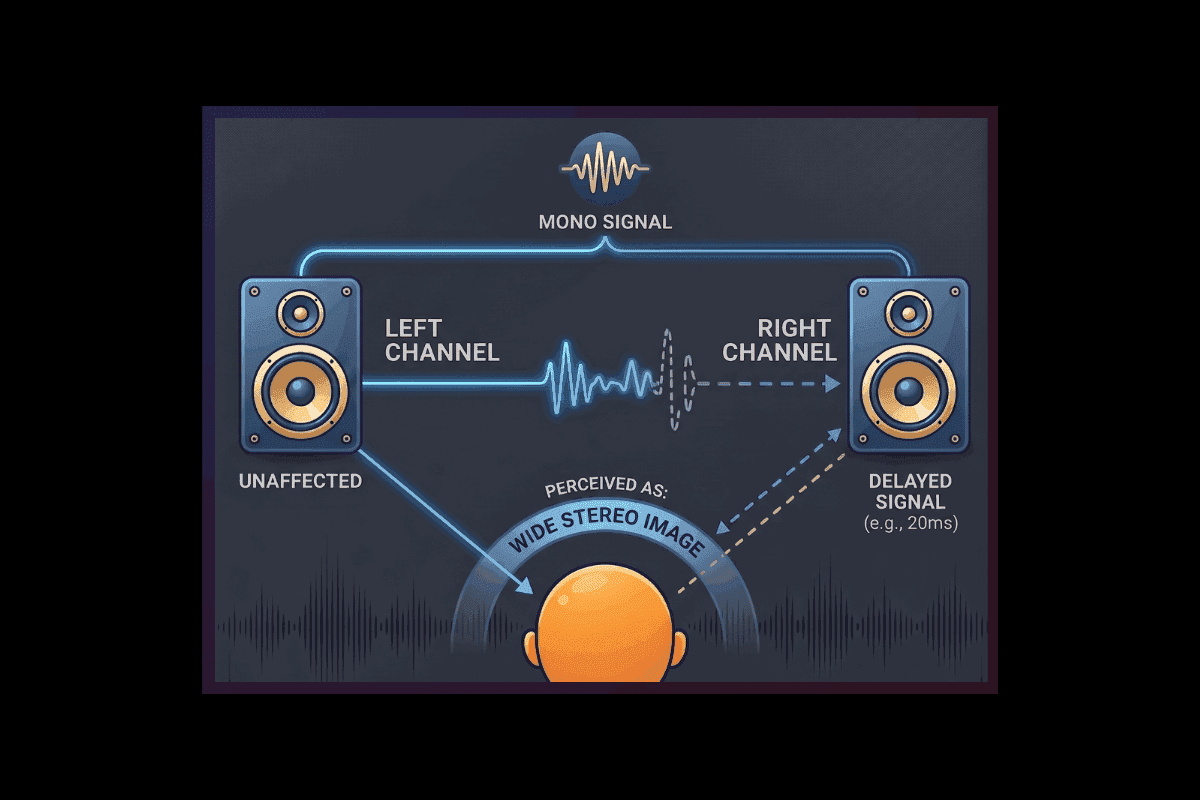
The Haas effect is based on a psychoacoustic principle called the precedence effect.
When two nearly identical sounds reach our ears within a very short period, our brain treats them as a single sound. Instead of hearing two separate signals, we perceive one sound that appears to come from the direction of the first arrival.
In music production, this principle is often used by placing a short delay on one side of a stereo signal. The delay is usually measured in milliseconds. Although the delayed signal is heard as part of the original sound, it creates the impression of width and space.
That is why the Haas effect is often described as a quick stereo widening technique.
The Haas effect changes perceived location and width. It is not the same as panning, and it is not a true stereo widener. Those distinctions become important once you start evaluating how the mix behaves outside your studio monitors.
When the Haas Effect Works Well
The Haas effect tends to work best on sounds that support the mix rather than define it. Think about elements that add texture, atmosphere, or movement.
Good Candidates for Haas Processing
- Pads
- Background vocals
- Vocal harmonies
- Reverb returns
- Delay returns
- Shakers
- Hi-hats
- Ambient textures
- Sound-design layers
These sounds often occupy the mid- and high-frequency ranges, where perceived width can add excitement without compromising the foundation of the mix.
For example, a backing vocal stack can feel much larger when a subtle Haas delay is applied. Likewise, a synth pad can spread across the stereo image and create a sense of depth behind the lead vocal.
A useful rule is to ask yourself a simple question:if this sound became quieter or partially disappeared in mono, would the song still work?
If the answer is yes, the Haas effect is usually a safer option.Many engineers prefer placing Haas processing on an auxiliary send rather than directly on the source track.
This makes it easier to blend the effect, automate it when needed, and remove it quickly if mono compatibility becomes a concern.
When You Should Skip the Haas Effect
The Haas effect is often treated as a universal widening solution. In practice, that is where most problems begin.
Some sounds rely heavily on clarity, punch, and stable positioning. Applying Haas processing to these elements can weaken the very qualities that make them effective.
Usually Better Left Untouched
- Kick drums
- Bass instruments
- Lead vocals
- Drum overheads
- Cymbals
- Snare drums
- Mono-critical instruments
- Important transient-heavy sounds
Low frequencies are a particularly poor match.
Humans are less sensitive to directional information in the low end, which means widening bass elements rarely delivers a meaningful stereo benefit. What it often creates instead is phase interaction and reduced low-frequency consistency.
Lead vocals can also suffer.
A vocal that sounds wide in stereo may become hollow, unfocused, or uneven when summed to mono. The same applies to drums and other transient-heavy material, where timing differences can soften impact and blur definition.
Before adding width, consider whether the sound needs more space or simply a better arrangement, EQ adjustment, or level balance.
Sometimes the cleanest solution is also the most effective one.
The Mono Test Every Producer Should Do
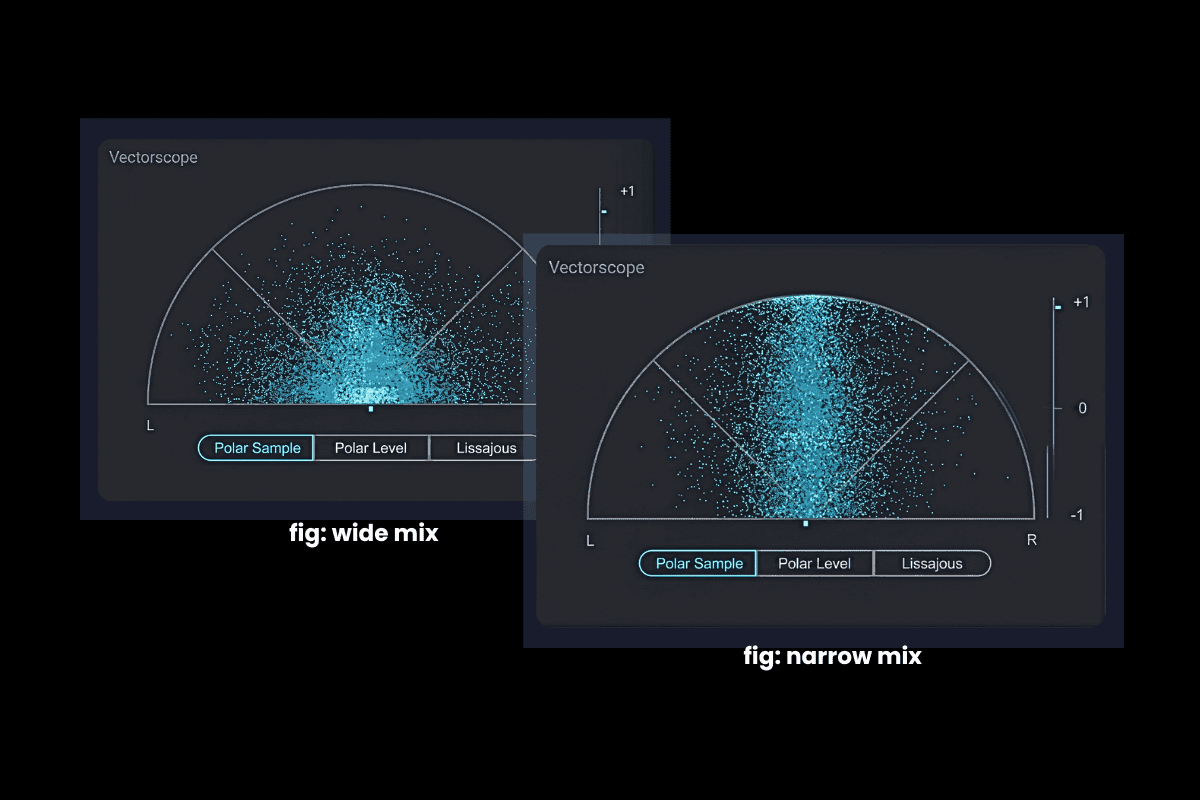
If there is one lesson that consistently appears in discussions among experienced engineers, it is this:
Always check the Haas effect in mono!
The reason is simple.
When the original signal and the delayed signal are combined into a mono source, certain frequencies reinforce each other while others cancel out. This creates a phenomenon known as comb filtering.
The result can be subtle or dramatic depending on the delay time and source material.
You may hear:
- a thinner sound
- reduced clarity
- changes in tone
- missing frequencies
- less impact
This matters because many listeners still encounter music through mono playback systems.
Bluetooth speakers, smart speakers, public-address systems, retail environments, clubs, and some mobile devices may not reproduce stereo information the same way your studio setup does.
A Practical Haas Workflow
Most Haas delays land between 10 and 30 milliseconds. Below that range, the effect is subtle. Past roughly 40 milliseconds, the delay starts to sound like a separate echo rather than a width.
- Apply the Haas delay.
- Switch your monitoring to mono.
- Listen for tonal changes.
- Adjust the delay time if necessary.
- Lower the delayed side slightly.
- Return to stereo and evaluate the width.
Many engineers also reduce the delayed side by several decibels and introduce small EQ differences between the two sides. These adjustments can help minimize unwanted phase interactions.
The goal is not to achieve perfect mono performance.
The goal is to make sure the widened sound still contributes positively to the mix when stereo playback is unavailable.
Other Ways to Widen Sound
| Double Tracking | Stereo Imaging Tools |
|---|---|
| Instead of delaying a copy of a sound, double tracking uses a second performance. It is best for Lead vocals, Guitars, and featured instruments. | When the goal is to improve width across the entire mix, stereo imaging tools are often a better fit than track-level Haas processing. |
| It typically delivers a more natural stereo image and stronger mono compatibility. | They provide greater control over stereo balance while helping preserve mono compatibility. |
Widen It, Then Remasterify It
Everything above happens while you mix. Stereo width is shaped track by track, before the song is finished. Mastering is the stage that comes after, and it treats the whole mix as one.
Once your track is finished, Remasterify takes it from there. It is an AI mastering tool that works on your final stereo mix rather than the individual tracks. Its genre-aware analysis studies the full track, then applies EQ, dynamics, loudness, and background noise removal in a single pass. You get a clean, balanced master without building a mastering chain by hand.
It also ties back to everything covered here. If the finished track feels too narrow or too wide, Remasterify gives you stereo width control at the master level. That means you can adjust width without reopening the mix. You can also fine-tune EQ and overall intensity by hand, or match the sound to a reference track you already like.
The automated settings give you a strong starting point. The manual controls let you shape the rest.
Frequently Asked Questions
What does the Haas effect do?
The Haas effect creates the perception of stereo width by delaying one side of a sound by a few milliseconds. Instead of hearing two separate sounds, the brain combines them into one wider sound. Producers often use it to make pads, backing vocals, and other supporting elements feel more spacious.
What is the difference between panning and the Haas effect?
Panning changes the level of a sound between the left and right speakers, which changes its position in the stereo field. The Haas effect uses a slight timing difference between channels to create a sense of width. In simple terms, panning moves a sound, while the Haas effect makes it feel wider.
Why is it called the Haas effect?
The effect is named after German physicist Helmut Haas, who published influential research on sound localization in 1951. His work helped explain how the brain determines the direction of a sound when multiple versions arrive at slightly different times. Today, the term is commonly used to describe a stereo widening technique based on those principles.
What is the Haas sound effect?
The Haas sound effect is a production technique that uses a short delay, usually between a few and a few dozen milliseconds, on one side of a signal. This creates the illusion of a wider stereo image without sounding like a distinct echo. It is commonly used in music production, sound design, and audio post-production.
What is the 7-second pan rule?
The "7-second pan rule" is not a recognized audio engineering principle and is not directly related to the Haas effect. The phrase occasionally appears in discussions about slowly automating panning movements to avoid distracting listeners, but there is no widely accepted industry rule that requires sounds to pan over seven seconds.