
An examination of how mastering shapes listener perception, the empirical findings that support its role, and the practical considerations that determine the quality of the final result.
Why Mastered Music Feels Different at Equivalent Loudness
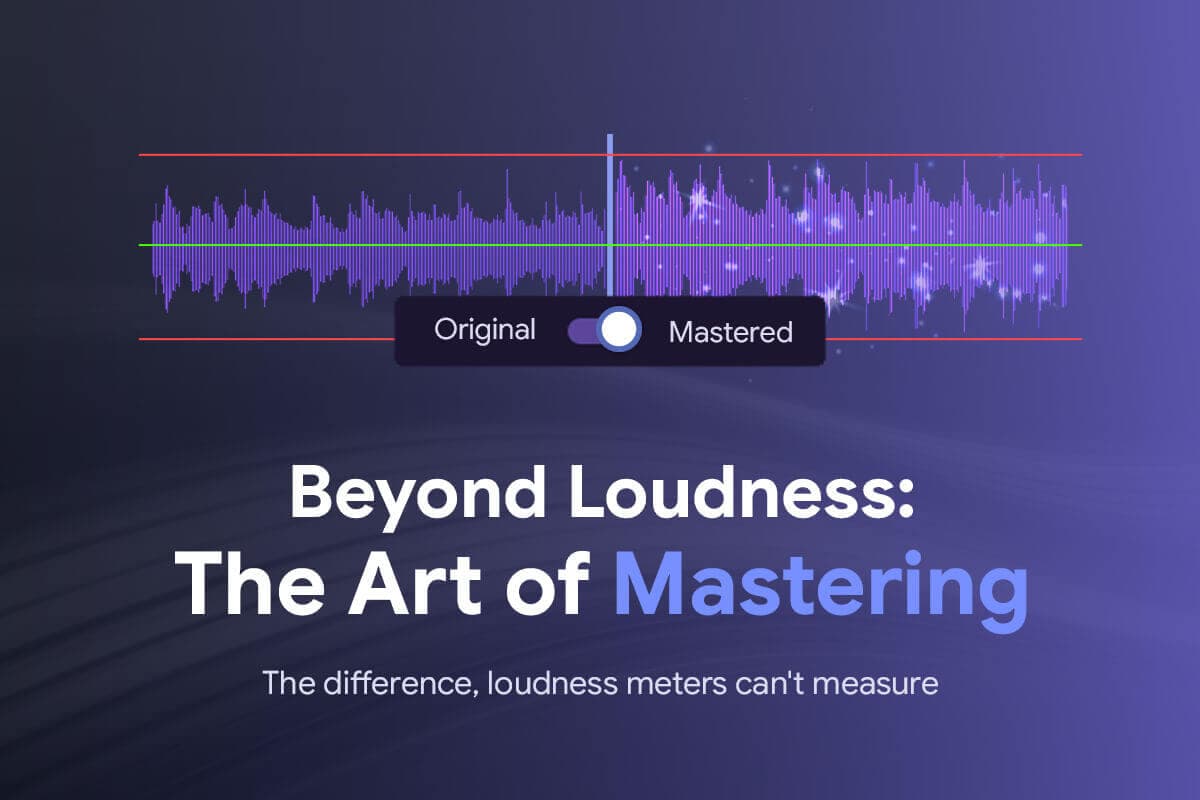
Mastering is frequently characterised within independent production communities as a technical formality, the final administrative step before release. The available empirical evidence indicates that this characterisation understates its function. In a controlled comparison conducted by Paton and McIntyre (2009), listeners presented with mastered and unmastered versions of the same recordings reported measurably different affective responses, even when both versions were level-matched. Mastered renditions were rated as more emotionally engaging, more dynamically coherent, and more perceptually defined. The difference, in other words, was not attributable to loudness.
This article reviews the perceptual and neurological basis for those findings, examines the consequences of releasing a track without a dedicated mastering stage, and outlines the preparation steps that determine the quality of the final result.
Contents
The neurological basis of musical perception
Musical listening is not a passive cataloguing of acoustic events. It is an active perceptual and emotional process that recruits regions of the brain associated with reward, memory, and motor planning.
A widely cited study published in Nature Neuroscience by Salimpoor and colleagues (2011) used combined positron emission tomography (PET) and functional magnetic resonance imaging (fMRI) to demonstrate that the intense pleasurable responses listeners report during peak musical moments — frequently described as “chills” — are accompanied by endogenous dopamine release in the striatum. The same reward circuitry is engaged by primary reinforcers such as food and by secondary reinforcers such as monetary reward. The full study is available via Nature Neuroscience.
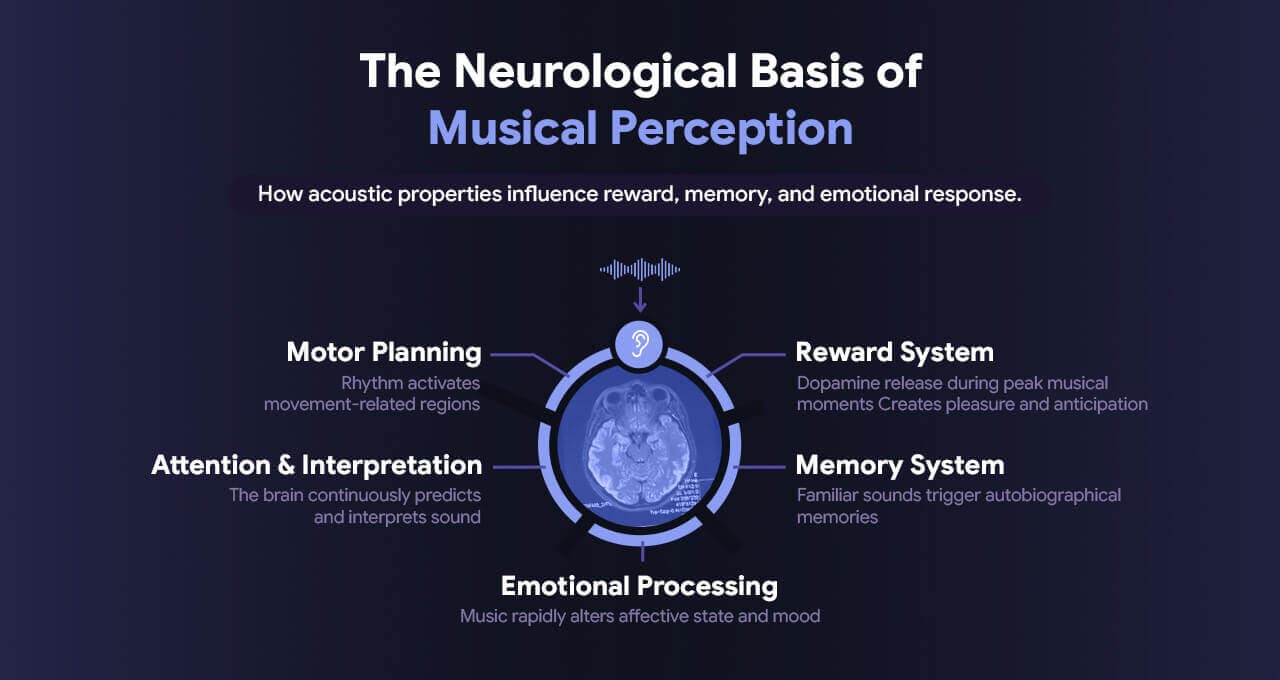
This neurochemical response is tightly coupled with autobiographical memory and affective state, which accounts for the speed with which a familiar passage can evoke a particular place, person, or mood. The implication for production work is direct: every acoustic property that shapes how a recording is perceived — spectral balance, dynamic behaviour, transient definition, stereo image — exerts continuous influence over the listener’s affective trajectory while the track is playing.
Mastering operates precisely on the acoustic properties that mediate the listener’s emotional response.
It is for this reason that the perceptual impact of mastering extends well beyond the technical refinement typically associated with the term. The final stage of production is not cosmetic; it modulates the variables that determine how the recording is felt.
The cost of releasing an unmastered recording
Omitting a dedicated mastering stage carries consequences that are seldom limited to a marginal loss of polish. The omission tends to undermine the listening outcomes the artist has otherwise worked to achieve.
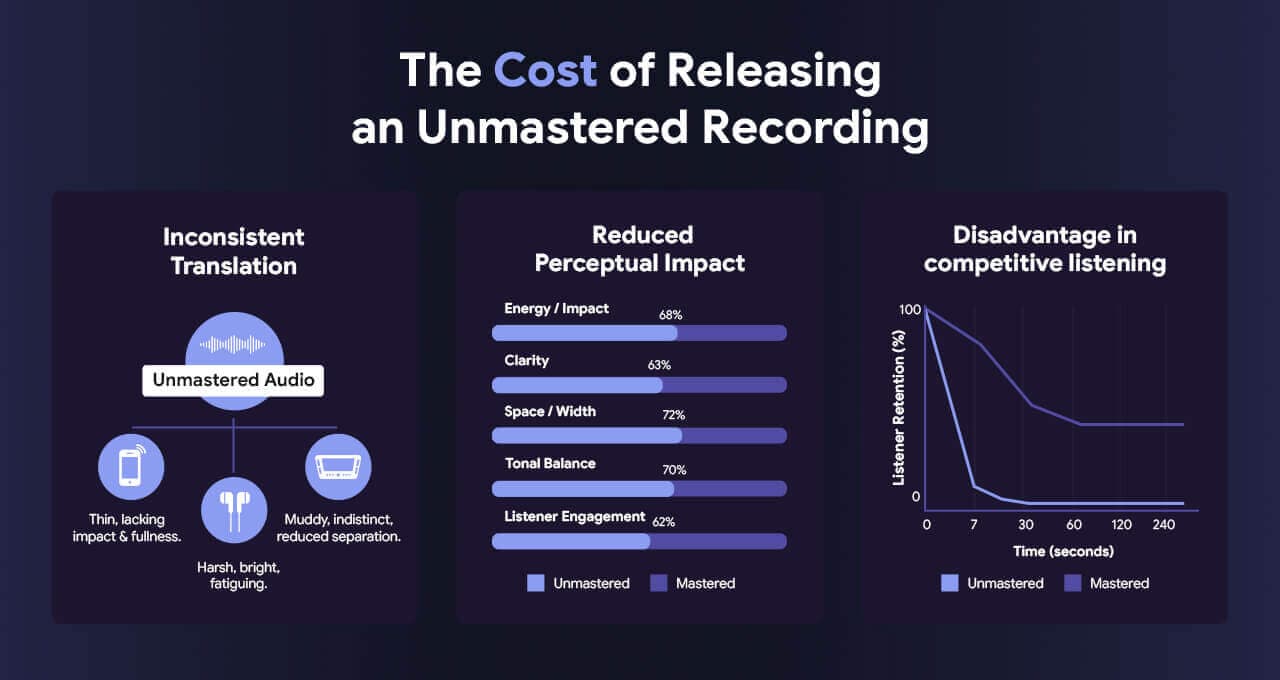
Inconsistent translation across playback systems
A mix that performs well on a single monitoring environment frequently fails to translate. The same recording may sound underweight on a mobile device, exaggerated on consumer earbuds, and indistinct in an automotive system. One of the principal aims of mastering is to produce a result that maintains its intended balance across a representative range of playback contexts, rather than only the environment in which the mix was finalised.
Reduced perceptual impact
Mastering decisions exert direct influence on the qualities to which listeners respond. The doctoral research of Shelvock (2017), which surveys both the practice and the perceptual literature surrounding mastering, reports that mastering choices measurably affect a recording’s perceived clarity, energy, sense of space, and tonal fullness. The disparity between what is captured in the mix and what reaches the listener is empirically observable, and mastering is the stage at which that disparity is addressed.
Disadvantage in competitive listening contexts
On curated streaming playlists, an unmastered recording is presented in immediate proximity to professionally finished material. Listeners typically register the discrepancy without being able to articulate its source. The unmastered track is perceived as less assured, and listener retention suffers accordingly. Given that platform algorithms weight early-skip behaviour heavily, the cost is not only aesthetic but also distributional.
Preparing material for the mastering engineer
The quality of a finished master is constrained by the quality of the file supplied. The following practices require minimal additional effort but materially affect the result.
Preserve adequate headroom
Final mix peaks should sit between approximately −3 dBFS and −6 dBFS, rather than approaching 0 dBFS. Adequate headroom allows the mastering engineer to apply processing without immediately encountering inter-sample peaks or the audible artefacts associated with aggressive limiting at the mixing stage. A mix delivered at or near full scale constrains the available creative and corrective options.
Export at full session resolution
If the project was tracked and mixed at 24-bit depth or higher, the bounce supplied for mastering should retain that resolution. Reducing bit depth or sample rate prior to mastering discards information that the engineer’s processing chain can otherwise exploit and is generally not recommended.
Supply reference material with specific direction
Two or three commercially released tracks that exemplify the intended sonic outcome provide the engineer with a concrete frame of reference. General statements of preference are less useful than localised observations: a comment such as “the low-frequency weight in this reference matches our intention” or “the vocal sits forward in the mix in a manner we would like to replicate” conveys actionable information.
Allow time for perceptual recalibration before final review
Prolonged exposure to a mix produces measurable listener fatigue and adaptation effects, and reduces the accuracy of self-evaluation. A break of several hours, and ideally an overnight interval, restores perceptual sensitivity. A subsequent listen frequently reveals issues that warrant correction before the file is committed to the mastering stage.
Pre-delivery checklist:
- Peak levels between −3 dBFS and −6 dBFS.
- File exported at the full bit depth and sample rate of the session.
- Two to three reference tracks supplied with annotated notes.
- Final review conducted after adequate auditory rest.
Mastering as a creative discipline
A persistent misconception holds that mastering consists of a generic finishing pass applied uniformly to all material.The mastering engineer and educator Bob Katz, in Mastering Audio: The Art and the Science, characterises the discipline differently, describing it as the final creative step in the audio production process. The qualifier is consequential: every adjustment available to the engineer alters the affective character of the recording.
The principal mastering processes and their perceptual correlates are summarised in the table below.
| Process | Coustic Adjustment | Perceptual Correlate | Affective Register |
|---|---|---|---|
| Equalisation | Refinement of spectral balance | Increased clarity, warmth, or brightness | Presence, intimacy |
| Dynamic compression | Controlled reduction of dynamic range | Tighter, more consistent dynamic behaviour | Energy, momentum |
| Stereo imaging | Adjustment of lateral width and focus | Broader or more concentrated soundstage | Spaciousness, depth |
| Harmonic saturation | Introduction of low-order harmonic content | Subtle enrichment of the signal | Warmth, textural character |
| Limiting | Final loudness optimisation and peak control | Competitive loudness with peak protection | Confidence, immediacy |
None of these adjustments is perceptually neutral. Each shifts the recording’s emotional register in a measurable direction. The mastering engineer is the final practitioner to shape the recording before it is released, and the creative judgement exercised at this stage has a direct bearing on how the work is ultimately received.
Concluding remarks
Every decision made during writing, arrangement, performance, and mixing is, in effect, an attempt to elicit a specific response from the listener. Mastering is the stage at which the integrity of those decisions is preserved on the path between the studio and the audience.
The empirical position is consistent across the studies reviewed: mastered material is perceived as more emotionally coherent and more sonically resolved than equivalent unmastered material, with the difference detectable independently of loudness. In a contemporary listening environment in which retention is determined within the opening seconds of playback, that perceptual clarity carries practical, not merely aesthetic, consequences.
A note on Remasterify
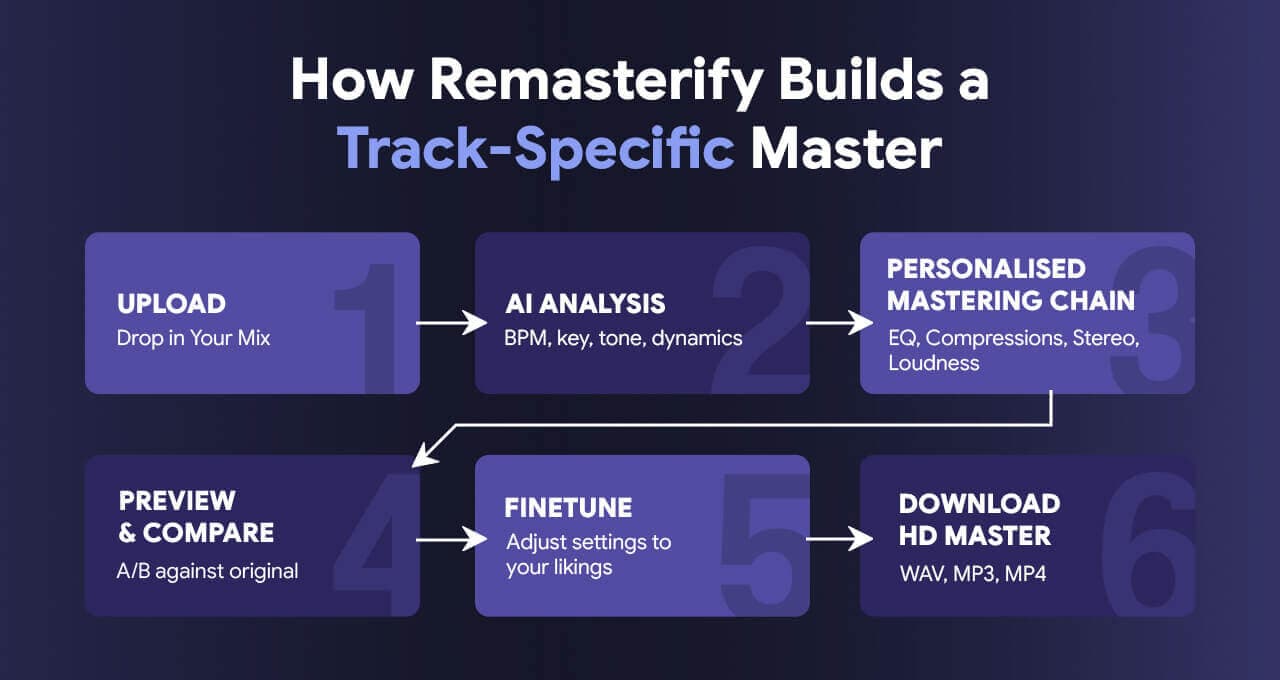
Remasterify was developed to address this final stage of production specifically. The platform performs per-track analysis — accounting for energy distribution, tempo, rhythmic character, and other sonic attributes — and constructs a mastering chain calibrated to the requirements of the individual recording, rather than applying a uniform preset. Outputs are calibrated to streaming-standard targets of −14 LUFS integrated loudness and −1 dBTP, so that finished material sits at parity with professionally mastered releases on Spotify, Apple Music, and comparable platforms. Processing is conducted by a proprietary model and completes within seconds, with manual parameter controls available to users who wish to refine the result further.
The intention placed into a recording is preserved only to the extent that the final stage of production is treated with equivalent care.
Frequently Asked Questions
What does audio mastering involve?
Mastering is the final stage of music production. It establishes the overall tonal balance of the recording, governs its dynamic behaviour, and prepares it for reliable playback across the range of devices on which it is likely to be heard, from mobile telephones and consumer earphones through to automotive systems and large-format reproduction. It is the process by which a finished mix is rendered into a release-ready recording.
Does mastering improve sound quality?
Yes. Mastering refines perceived clarity, regulates frequency balance, and establishes a consistent loudness and tonal character across a release. Listener studies, including the controlled comparison reported by Paton and McIntyre (2009), have demonstrated that mastered renditions are rated as more emotionally coherent and more engaging than unmastered equivalents, with both presented at equivalent loudness.
What does basic mastering consist of?
At its most reduced description, mastering comprises four operations: equalisation to refine the spectral balance, dynamic compression to govern dynamic behaviour, stereo adjustment to shape width and focus, and limiting to establish final loudness. The relationships between these operations determine how the recording sits in a playlist context and how it is perceived by the listener.
How is a recording typically mastered?
The completed mix is supplied to a mastering engineer, or to an algorithmic mastering system, which analyses the material, applies the four core operations described above, and produces a deliverable file rendered at the appropriate loudness and format for its intended distribution channel, whether streaming, optical media, or vinyl. Most contemporary releases are mastered to approximately −14 LUFS with a −1 dBTP ceiling for compliance with streaming platforms such as Spotify and Apple Music.
In what respect does Remasterify differ from other algorithmic mastering tools?
Remasterify performs per-track analysis, evaluating energy, tempo, rhythmic character, and additional sonic attributes, and constructs a mastering chain calibrated to the specific requirements of the recording in question. Processing is completed within seconds, and manual parameter controls are available to users who wish to refine the result further.