
The Truth About EQ for Acoustic Guitar (And Why Your Ears Matter More Than Presets)

If you've ever spent an hour scrolling through forum threads looking for the "perfect EQ settings" for acoustic guitar, you already know the punchline: there aren't any. Ask ten engineers, and you'll get ten different answers, usually followed by some version of "it depends on the guitar." That answer is frustrating when you're staring at a muddy mix at 1 a.m., but it's also the most honest thing anyone in audio will ever tell you.
The good news is that the lack of a universal recipe doesn't mean acoustic guitar mixing is a guessing game. There are patterns, common problem zones, and reliable starting points that almost every working engineer agrees on. Pair those with a transparent, musical EQ and trained ears, and you can make almost any acoustic recording sound rich, woody, and alive in the mix.
Start With the Source, Not the Plugin
Before we talk about frequencies at all, it’s worth repeating what nearly every professional says: mic placement beats EQ, every time. A microphone moved two inches toward the bridge will change the tone more than a six-decibel boost ever could. If your raw recording sounds boomy, nasal, or harsh, no amount of plugin wizardry will fully fix it. You’ll just be sculpting flaws into different flaws.
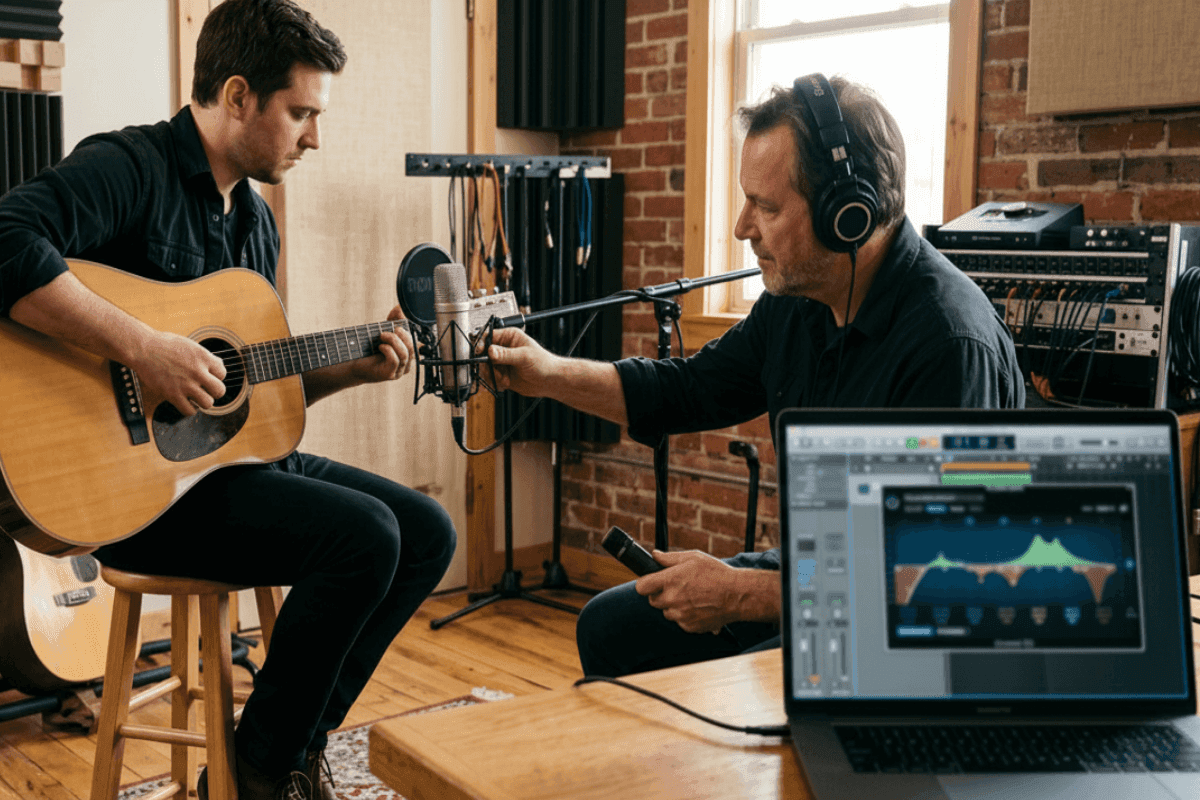
The same thing applies to direct recordings. When you plug an acoustic guitar straight into youraudio interface using its built-in pickup, the sound often comes out thin and squeaky, a tone nobody enjoys mixing. You can’t fix this with a clever EQ setting. The real solution is to either record the guitar with a microphone or mix the pickup sound together with a mic signal so it sounds fuller. EQ is meant to polish a recording, not save a bad one.
The Frequencies That Actually Matter
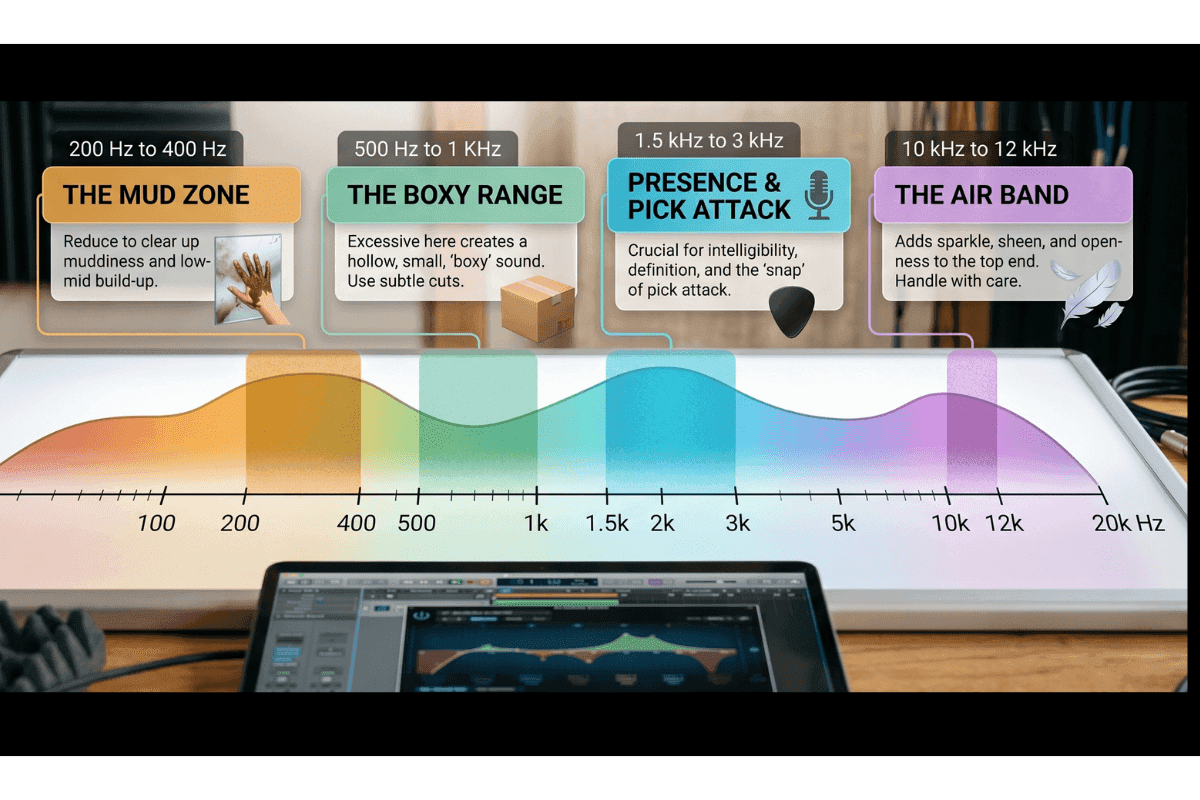
Across thousands of mixing discussions, a few zones come up again and again as the usual suspects for acoustic guitar:
200 Hz to 400 Hz — the mud zone.
A gentle cut here cleans up boominess, especially on dreadnoughts or anything recorded close to the soundhole. Pair it with a high-pass filter around 80–100 Hz to clear out sub-rumble, almost reflexive in a dense mix. But when the guitar is the only instrument behind a vocal, keep more of that low-end warmth. It’s what gives a solo performance its body.
500 Hz to 1 KHz — the boxy range
When a guitar sounds “boxy” or like it’s stuffed in a cardboard tube, this is usually where the problem lives. A small, narrow cut works wonders.
1.5 kHz to 3 kHz — presence and pick attack.
A subtle boost here helps the guitar cut through a busy arrangement and adds definition to fingerpicking patterns. Too much, though, and you'll get harshness on strummed performances.
10 kHz to 12 kHz — the air band.
This is where engineers reach for that "sparkle" or "open" quality. A gentle high shelf adds the kind of smooth, expensive-sounding top end that makes listeners describe a track as "professional" without quite knowing why.
The recurring theme? Subtle moves. Small adjustments of one or two decibels almost always beat aggressive sculpting. Acoustic guitars are delicate instruments, and they punish heavy-handed EQ faster than almost any other source.
Words to Mix By
Listen to how seasoned engineers describe a great acoustic tone: woody, warm, airy, natural, bright but not harsh, smooth on top. These aren't technical terms; they're targets. Before you touch a single knob, decide which of those words your track needs more of. Mixing without a sonic destination is how people end up over-EQing.
If a guitar sounds harsh, you don’t need a tutorial. You need less in the 3–5 kHz region. If it sounds dull, you need more somewhere above 8 kHz. Naming the problem in plain language is half the work.
Why the Tool Still Matters
Here's where things get interesting. Plenty of mixers will tell you that any stock parametric EQ can do the job and they're right, in the strictest technical sense. But there's a reason names like Pultec, Neve, API, and Helios keep coming up in the same conversations as "warmth" and "musicality." Quality EQs aren't just about frequencies; they're about how those frequencies move. The character of the curves, the gentle saturation as you push gain, the way bands interact with each other: that's where the magic lives.
The same idea applies once the mix is done. At the mastering stage, generic processing can flatten the warmth and air you spent so much time shaping. A tool like Remasterify approaches it differently, it analyzes the track first and builds a mastering chain tuned to that specific song, so a fingerpicked ballad isn’t treated like a full-band strummer. If the AI’s EQ choices don’t match your ears, you can switch to manual sliders and shape things yourself. None of it replaces the EQ work on the guitar bus; it just keeps that work intact through the final stage.
The Real Rule
After all the frequency talk, the gear lists, and the techniques, the consensus comes back to three short phrases that working engineers repeat like a mantra: Use your ears. EQ for the song. There are no fixed rules.
A great EQ won't replace those instincts — but the right one will help you trust them faster.
Frequently Asked Questions
How should I EQ an acoustic guitar?
Start with mic placement, not the plugin. Once the recording is solid, work in subtle moves: high-pass around 80–100 Hz, gentle cut at 200–400 Hz if it's muddy, small cut between 500 Hz and 1 kHz if it's boxy, light presence boost around 1.5–3 kHz, and a soft high shelf at 10–12 kHz for air. Keep moves within one to two decibels.
What does EQ do on a guitar?
EQ lets you boost or cut specific frequency ranges in the guitar's tone — reducing boominess, cleaning boxiness, adding pick definition, or opening up the top end. It shapes what's already there. It's a sculpting tool, not a fix for a bad recording.
Is 1176 good for acoustic guitar?
Yes, when used with intent. The 1176 excels at taming aggressive pick attack and inconsistent dynamics. Try a slower attack and a 4:1 ratio. For smoothness and glue, an LA-3A-style optical compressor is usually the better choice.
How should I EQ my guitar?
It depends on the guitar, the part, and the song. Name the problem first: muddy lives around 200–400 Hz, boxy between 500 Hz and 1 kHz, harsh around 3–5 kHz, dull means you need more above 8 kHz. Identify it, then make the smallest move that solves it.
Make your track release-ready.
Fix noise, clarity, and volume in seconds.