
You're not making music for speakers; you make music for human ears. It took me some years to realize this. And now I’m making music that sounds a little more shaped. My secret to balancing the tone is referencing pink noise while I mix.
How I achieved natural tonal balance (Pink noise is my secret)
How human ears actually hear loudness
After spending a majority chunk of my productive time reading NIH journals, I discovered a few facts. The first among them sound is not heard evenly.
Human ears do not treat all parts of a song the same way. Some frequencies feel louder than others, even when they are technically at the same level.
For example, the midrange (where vocals sit) is naturally more sensitive to our ears. That is why a vocal can feel too sharp or too forward even if it is not the loudest element in the mix.
On the other hand, low frequencies like bass and kick often need more energy to feel equally present.
This uneven perception is part of why mixes can feel “off” even when everything looks fine on screen.

Ear fatigue
Because our ears are so sensitive, a mix with too much "upper-mid" energy will cause your listener's ears to tire out quickly, often leading them to turn the music down or off.
Spending too much time with sound can make you lose the ability to hear sound details. Most of time, you cannot hear the high-mid and high frequencies (2kHz to 5kHz) when experiencing ear fatigue.
A track might be technically balanced in terms of levels, but still feel too heavy, too thin, or too harsh when listened to normally.
Once this clicked, it changed the way balance was approached. It stopped being about numbers and started being about how the song feels when heard as a whole.
Why mixes sound different on different speakers
Another major issue shows up when the same mix is played across different systems.
A track that sounds controlled on studio headphones can feel overly bass-heavy in the car. Something that feels clear on monitors can sound dull on laptop speakers. Earbuds can make the top end feel sharper than expected.
This happens because every playback system emphasizes sound differently. Some boost low frequencies, some reduce them. Some highlight the upper range, while others smooth it out. On top of that, room acoustics and listening environments also change how sound is perceived.
This is often referred to as “translation” — how well a mix holds up across different listening situations.
When tonal balance is not right, translation becomes inconsistent. The mix keeps changing character depending on where it is played. That is usually a sign that certain parts of the frequency range are either too dominant or too weak.
A well-balanced track tends to travel better. It may not sound identical everywhere, but it stays stable enough to feel right in most places.
How pink noise became my mix reference
Things are getting more interesting here. I incorporated pink noise for help, specifically even out the tone.
Pink noise is a type of noise that distributes energy evenly in a way that roughly matches how humans perceive sound. Instead of treating all frequencies equally, it follows a natural slope where lower frequencies carry more energy and higher frequencies gradually reduce.
Using pink noise as a reference gave a new perspective on tone balance.
The process was simple. While mixing, I would compare my track against a pink noise level and slowly bring in different elements to see how they sit against that baseline. It was not about matching it perfectly, but about noticing patterns.
To make this handy, I uploaded pink noise in my DAW.
Some parts would disappear too quickly, which meant they were too weak. Others would dominate too early, which meant they were too heavy. It helped highlight where the mix was leaning too far in one direction.
Referencing pink noise did not magically fix everything, but it made imbalance easier to spot.
Over time, this helped train the ear to recognize when a mix felt too crowded in the low end, too sharp in the upper range, or lacking body in the middle.
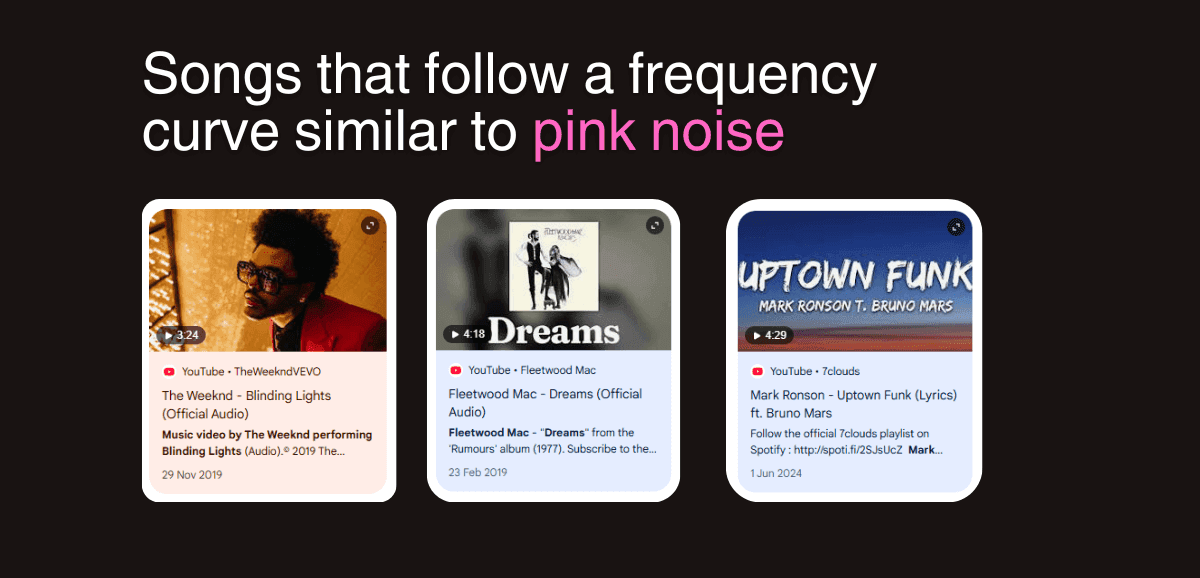
Most commercially successful songs follow a frequency curve similar to pink noise (a slope of roughly 3dB per octave)
Human ears do not perceive all types of frequencies equally. We hear in octaves (not in a linear fashion)
Pink Noise Has equal energy per octave. It loses power at a rate of roughly 3 dB per octave as the frequency increases. This matches our hearing's logarithmic nature, making the noise sound "flat" or balanced across the entire 20 Hz to 20 kHz range.
First, it combats ear fatigue
Second, it eliminates listener bias. You might naturally want to push your favorite guitar solo too loudly. Pink noise forces you to level it based on its frequency content rather than your emotional attachment to the part.
Pink noise has the perfect distribution of energy. That's why it sounds more consistent across different playback systems (car speakers to headphones)
Where manual referencing still falls short
Even with something like pink noise, the process is still manual.
It takes time to go back and forth, adjust elements, re-check, and compare again. It also depends on judgment. Two different people can interpret the same mix differently, especially when working in less-than-ideal listening environments.
There are also limitations.
Pink noise does not adapt to genre. A hip-hop track, an acoustic song, and an electronic mix will not all follow the same balance. Trying to apply a single reference across all styles can sometimes lead to over-correction.
Genre-specificity plays a major role in mixing. There are some genres where pink noise will not help balancing the tone, rather it will mess up the audio.
For example, using pink noise to balance out experimental “noise” rock music can make the sound flat. It will mask some specific frequencies to adjust the tone. It will miss the intentional goal to make mixes harshy or overwhelming.
And then there is the practical side. After a while, ears get tired. What sounded balanced earlier can start to feel different after long sessions. That makes it harder to trust decisions consistently.
“ It happened to me many a times. When I spent too much time (exceeding 6 hours) for mixing, I hear many sounds dull. A tired brain can make mistakes. Then I decided to try AI for this tedious task. Remasterify AI is my first choice because it balances my tones within a few seconds. ”- Creed
So, while referencing pink noise helped, it still felt like a process that required constant attention and second-guessing.
Therefore, letting your ears decide what your mixes sound is not a good idea always. Even though it looks convenient many times.
How AI can automatically fix uneven tone
Listening to your mixes in different frequencies is a tiring process, honestly speaking. This is where tools like Remasterify start to make sense.
Instead of manually checking where the mix feels too heavy or too sharp, AI-based mastering tools analyze the track as a whole and identify imbalances across the frequency range.
Our idea is not just to increase loudness, but to shape the overall tone so it feels more even and controlled.
Remasterify does this by automatically adjusting areas where the mix is leaning too far in one direction. If the low end is dominating, it gets tightened. If the upper range feels harsh, it is smoothed out. And when the mix lacks clarity, the middle is brought forward in a more natural way.
What makes this useful is that it removes a lot of guesswork.
We can give up various laborious tasks like repeatedly comparing, adjusting, and checking across multiple systems, the track moves closer to a balanced state in a more direct way. This is especially helpful when working in home setups where monitoring is not always reliable.
The result is not about making the track perfect, but about making it feel more stable, more consistent, and balanced. As Remasterify makes your mixes ready for release across real-world listening situations.
And for many creators, that is the part that matters most...getting the song to a point where it finally feels finished. Doesn't it?
Make your track sound more balanced
Fix uneven tone to feel your mixes clearer, fuller and more consistent across systems.